China routinely objects to Indian leaders' visits to Arunachal Pradesh to buttress its stand.

'It was China's rise that caused the New Cold War in Asia as it prompted the United States to rebalance its forces in Asia to experiment with engagement and containment at the same time,' says T P Sreenivasan.
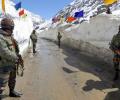
The clear assertion by New Delhi came ahead of a fresh round of Lt General-level talks between the Indian army and the Chinese PLA which government sources said is set to take place within the next two days.

The Chinese envoy said that the India-China bilateral ties can't take the strain of another Doklam episode
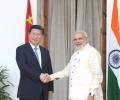
With the continuing stand-off in Ladakh casting a shadow over the Sino-India talks, Prime Minister Narendra Modi on Thursday raised 'serious concerns' over the repeated incidents along the border and sought an early settlement of the boundary question.
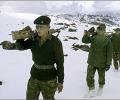
Virtually defending the latest incursion by the People's Liberation Army in the Chumar sector in Ladakh, China on Thursday said its troops were patrolling on its side of the Line of Actual Control and asserted that "status quo" should not be changed pending a final settlement.

President Pranab's four-day visit to China that saw him meeting the top Chinese leadership and discussing the sticky boundary issue and cooperation in combating terrorism besides the need for a predictable nuclear regime.

India and China on Wednesday signed in all nine agreements, including the Border Defence Cooperation Agreement and one on strengthening cooperation on trans-border rivers, after restricted and delegation-level talks that lasted over two hours as Prime Minister Manmohan Singh and Premier Li Keqiang met for the second time this year for talks which the Indian leader described as "fruitful and productive".

'We should carefully handle issues concerning each other's core interests. We should properly manage and control problems that cannot be solved for the time being'
Instead of "the dragon and the elephant compete with each other", "the dragon and the elephant dance together, Chinese Foreign Minister Wang Yi said.
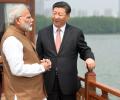
The BRI, a pet initiative of President Xi, is aimed at promoting network of roads, ports and rail networks all over the world to spread China's influence.

'The immediate attempt by China is to get its way and gain territory through small steps without having a full-scale war.'

'India has to prepare for future warfare where kinetic use of force at the border will be limited. War will take place in the realms beyond the border.'

India said a new mechanism will be set up for issues relating to trade and investment.

Modi also said the people of India felt proud that President Xi has twice received him out of the capital.

He stressed the need for strengthening mutual trust and confidence while seeking solutions to outstanding issues.

For the first time, the Chinese military on Thursday acknowledged last year's incursion at the DepsangValley in Ladakh region and said such incidents occurred due to different perception about the Line of Actual Control.

Carrying a message of "peaceful cooperation" from his President for the new Prime Minister, Chinese Foreign Minister Wang Yi on Monday exuded confidence that both the countries have the capabilities to deal properly with the contentious issues such as boundary dispute.

Closed meetings are not open to the public and no verbatim record of statements is kept.

Answering questions on the clashes near Naku La Pass in the Sikkim sector which resulted in injuries to both sides, Chinese Foreign Ministry spokesman Zhao Lijian said that the most pressing issue for the world at present is the fight against the coronavirus.

Xi will attend the second informal meeting with Modi at Mahabalipuram near Chennai from October 11 to 12 and pay a state visit to Nepal on October 13, Foreign Ministry spokesperson Hua Chunying announced on Wednesday.
'We should not minimise the seriousness of Chinese encroachments because their perception is different.' 'Nor should we fall into the trap of accepting so-called 'buffer zones' in areas of overlapping claims. We cannot have buffer zones in our own territory,' asserts Ambassador Shyam Saran, a former foreign secretary.

'Does the Indian army's new assertiveness risk a clash escalating into shooting and possibly skirmishes?' asks Ajai Shukla.

Poland, which currently holds the council's rotating presidency, has listed the matter for discussion at 10 am on Friday, the diplomats were quoted as saying.

'India has ramped up infrastructure on its side, so the Chinese military is finding Indian soldiers in locations where they are not used to seeing an Indian footprint,' points out Harsh V Pant.

'India stands to gain immensely by forging a developmental partnership with China.' 'While through sustained strategic communication there is scope to steadily expand the commonality of interests between the two countries.' 'This is also a practical way to ensure that differences do not get over-magnified and become disputes,' says Ambassador M K Bhadrakumar.

Arpi deserves to be complimented for the commitment and hard work that have gone into this production. The frustrations of seeking reliable documentation from the catacombs of the Indian bureaucracy did not deter him from going after the best information available, and the result is one that he can take much satisfaction in. Ambassador Prabhat P Shukla, Member Advisory Council, Vivekananda International Foundation, reviews Claude Arpi's The End of an Era: India Exits Tibet.
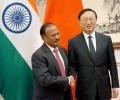
'Russian diplomacy is presumably at work.' 'The ground is slippery, because "territorial sovereignty" is a hugely sensitive issue,' says Ambassador M K Bhadrakumar.

'In Chinese perception, India is strategically getting closer to United States and some Chinese analysts fear perhaps one day it may become a part of American arrangements against China.'

One thing Beijing must understand is that India is not obsessed with being a threat to China but only wants a rightful place for itself in the world, says Sanjeev Nayyar.

Once again an Indian prime minister has realised that with Pakistan and China, things will not move as he wishes.

Though the Chinese find it necessary to oppose the visits of Indian leaders to Arunachal Pradesh, they want to keep the objections at a moderate level lest it cast a shadow on Narendra Modi's visit to China in May, says D S Rajan.

India and China decided to seek a fair and rational solution to their border dispute on Saturday as they focused on the proposed border defence cooperation agreement to avert incursions like the one witnessed in Leh region last month.

As Chinese army incursions continue to recur, India has cautioned China that any disturbance of peace and tranquility in the border areas can vitiate the overall atmosphere of bilateral ties.

Following is the full text of Prime Minister Manmohan Singh's speech at the Central Party School in Beijing on Thursday:
